
Here is the short version: a move-out clean is pass-or-fail, not a tidy-up. A tenant or property manager walks the empty unit against a standard, and if the oven has baked-on grease or the baseboards have dust, you get a callback, a deposit fight, or a lost account. The fix is a written room-by-room checklist your crew follows the same way every time, a price built on condition instead of square footage alone, and before-and-after photos that end the argument before it starts. This post hands you the checklist to steal, the move-in version, the pricing math, the failure modes that blow your estimate, and the follow-up that turns one unit into a standing property-manager account.
I spent nine years running a residential maid service before I moved into systems work, and move-out cleans taught me the most expensive lessons. A recurring clean is forgiving: miss a spot, fix it next week. A move-out has no next week. The unit is empty, the keys are changing hands, and somebody with a deposit on the line is hunting for a reason to deduct. Every figure here is sourced.
Sources: Angi move-out cleaning cost (2026); Thumbtack (updated 2026); Wise security deposit guide; Marketdata residential maid services.
Key Takeaways
- Move-out is pass-or-fail. It is graded against an inspection standard, so a written checklist beats a good memory.
- Price on condition, not square footage. A trashed two-bed can take longer than a tidy four-bed. Walk it or build in a condition multiplier.
- Inside surfaces are where you lose. Oven, fridge, cabinet interiors, baseboards, and window tracks are what inspectors check and crews skip.
- Photos end disputes. A date-stamped before-and-after set is the cheapest insurance on a deposit fight.
- One unit can become a route. The property manager who sends this unit has more. Nail the first and ask for the next.
Table of contents
- Why a move-out clean is a different animal
- What getting it wrong actually costs you
- Steal this: the room-by-room move-out checklist
- How to price a move-out clean so it stays profitable
- Failure modes that blow past the estimate
- Document everything: the photos that win disputes
- Running the checklist at three sizes
- Turn one move-out into recurring revenue
- Objections, answered straight
- Frequently asked questions
Why a move-out clean is a different animal
It is 4:15pm Thursday and your crew just texted that the “quick two-bed move-out” will run another two hours, because the previous tenant fried bacon every morning for three years and never touched the oven. You quoted $190 flat. You are losing money by the minute, and the leasing office wants the unit turned by ten tomorrow.
That scene is the whole problem. A recurring clean keeps a lived-in home cared for. A move-out returns an empty unit to a documented standard so a deposit gets released or a new tenant moves in. Nobody lives there to lower the bar, and a specific person, tenant, landlord, or property manager, has money riding on how clean it is. The demand is real: about 16% of US households now pay for cleaning, double the 8% share in 2012 (Marketdata, via ISSA).
What getting it wrong actually costs you
The average move-out clean runs about $360, with most jobs between $132 and $541 by size and condition (Angi, Thumbtack). One failed inspection eats that revenue. A callback is a second trip at full labor and drive cost with zero new revenue, worse on a move-out because the unit may be locked and a new tenant moving boxes through your redo. A deposit dispute is uglier: the standard security deposit is about one month’s rent (Wise), and cleaning is a deduction a landlord can legally take when a unit is left below standard (Apartments.com). When a tenant hired you to protect that deposit and it gets docked anyway, you are the name on the bad review.
The biggest loss is quiet. Property managers do not argue, they just stop calling. One PM who hands you three or four turns a month is worth more over a year than a dozen one-off homeowners, and you lose the stream the first time a unit fails.
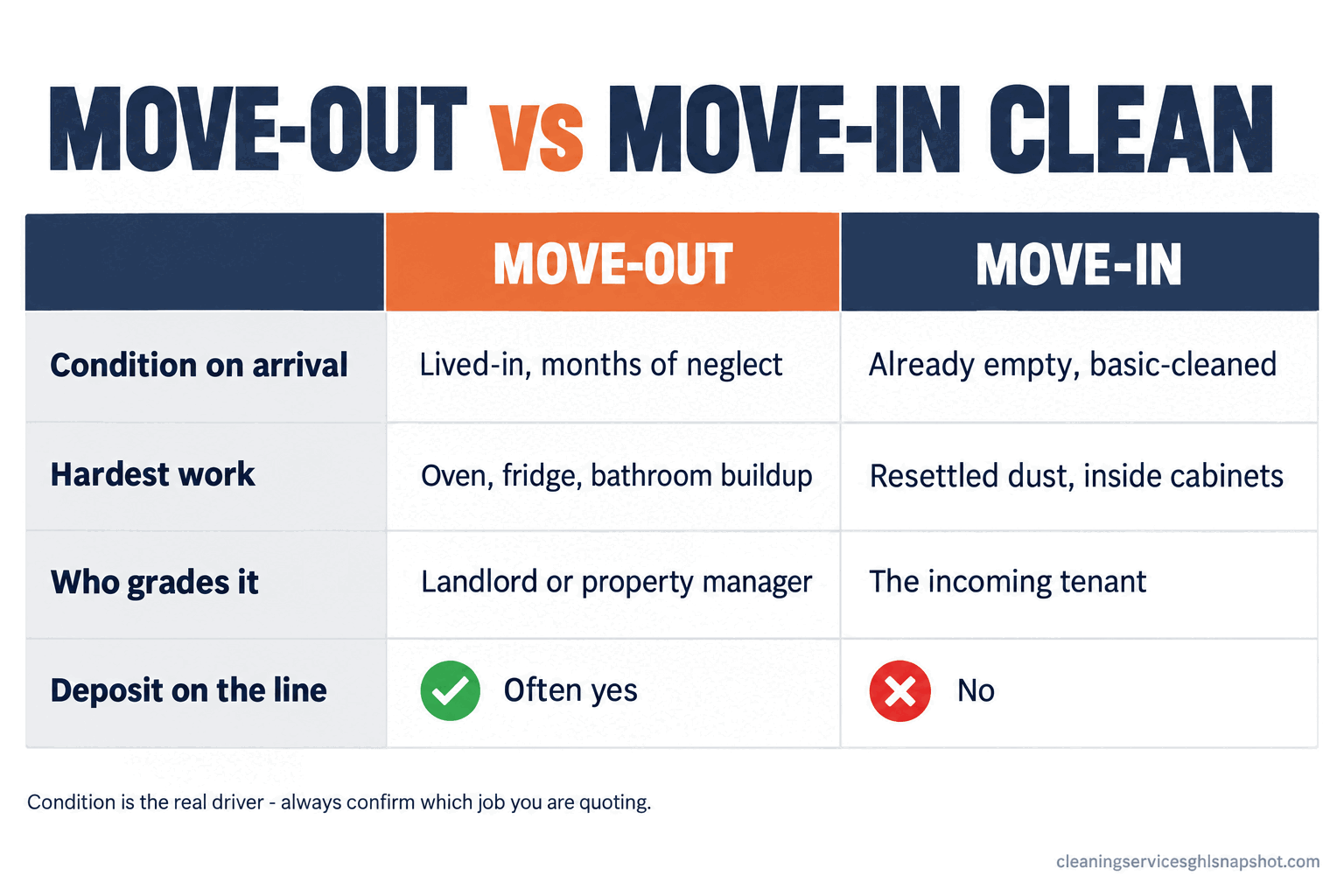
Move-in vs move-out: what changes
People lump these together as “move cleans,” but the crew does different work and the quote should reflect it.
| Factor | Move-out clean | Move-in clean |
|---|---|---|
| Condition on arrival | Lived-in, often months of neglect | Usually already vacated and basic-cleaned |
| Hardest work | Oven, fridge, bathroom buildup, baseboards | Dust resettled since last clean, inside cabinets |
| Who is judging it | Landlord or PM against an inspection standard | The incoming tenant, first impression |
| Deposit on the line | Often yes, the outgoing tenant’s | No, but sets the tone for the tenancy |
| Typical time vs standard clean | 1.5x to 2.5x longer | 1.2x to 1.5x longer |
Illustrative. Condition is the real driver, so always confirm which job you are quoting and in what state the unit will be.
Never quote a move clean until you know which one it is and what shape the unit is in. A smoker’s “move-out” with two dogs is a different job from a “move-in” the landlord already basic-cleaned, even at the same square footage.
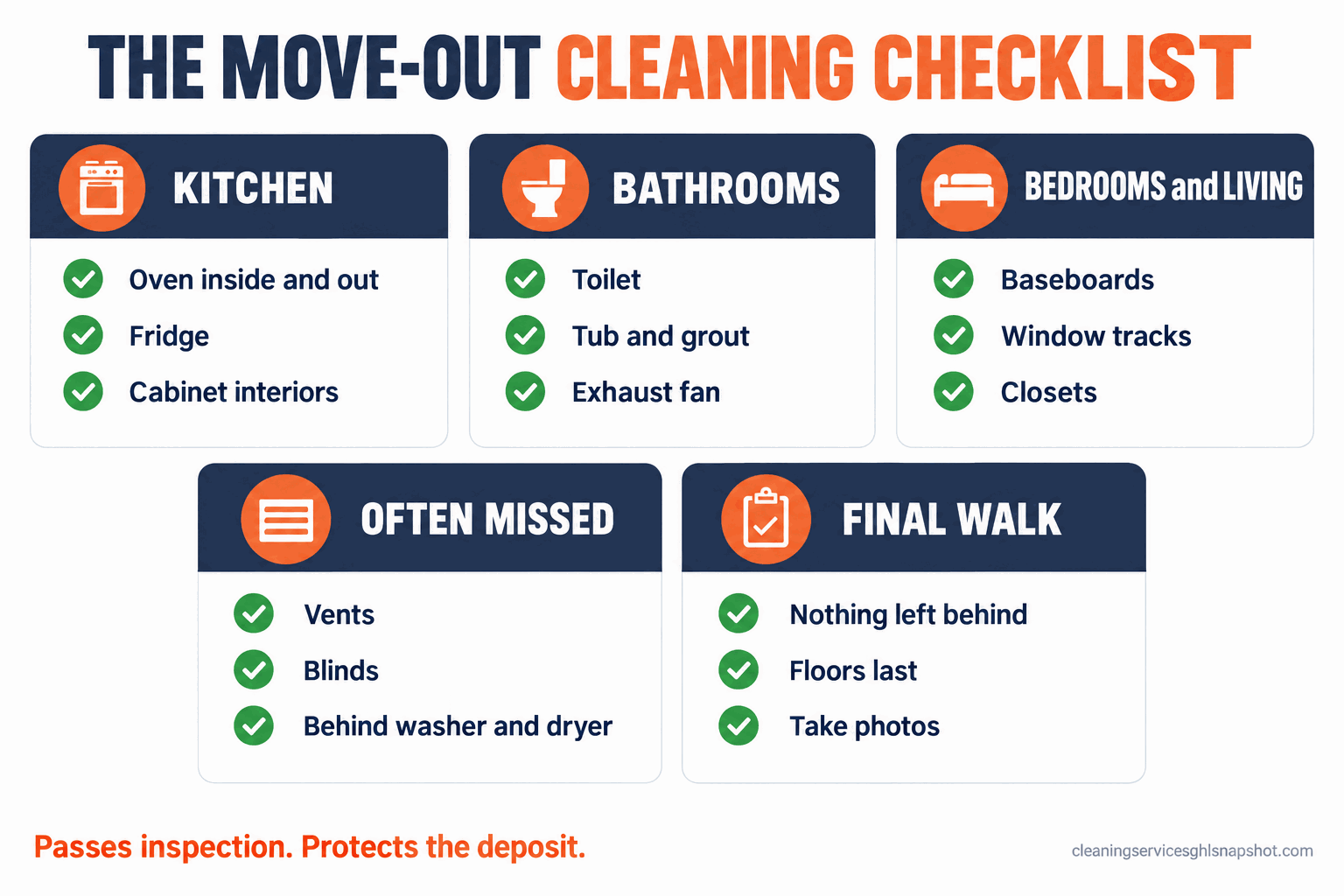
Steal this: the room-by-room move-out checklist
Copy this into a note or your job app and hand it to every crew. The power is not the list of rooms, it is the inside surfaces most crews walk past.
That inside-the-appliance block is where the job is won or lost. A leasing agent opens the oven and fridge first. If those two are spotless, the inspection is a formality.
You also want three short messages ready, where move-outs leak time.
That follow-up text is the one that turns a $200 job into a recurring account.
The move-in checklist: what is different
A move-in starts from an already-empty, usually basic-cleaned unit, so you are not scrubbing three years of oven grease. Run the same room-by-room structure but shift the weight: less appliance degreasing, more wiping inside cabinets and drawers again (dust and residue collect fast in a vacant unit), window interiors and tracks, and sanitizing the bathroom and kitchen surfaces the tenant touches first. A move-in sets the tenant’s expectation for the whole lease, so streak-free mirrors and a fresh, not chemical-harsh, unit earn the repeat booking.
How to price a move-out clean so it stays profitable
Square footage alone will sink you, because a filthy 900-square-foot apartment can take longer than a tidy 2,200-square-foot house. Price on condition, with size as the starting point and a multiplier for how bad it is. Move-out pricing by home size looks like this nationally, before condition.
Midpoint of typical move-out price by apartment layout, US 2026. Source: Angi. Houses and heavy-condition units price higher.
The method that keeps you out of the 4:15pm trap: set a base rate by size, then multiply by condition, light (kept, 1.0x), average (normal wear, 1.3x), heavy (neglect, pets, smoke, 1.6x to 2.0x). Walk the unit or require photos first. If you cannot see it, quote a range and say that heavy buildup moves it to the top.
Whatever you charge has to clear your true cost per on-site hour: loaded labor plus drive time, supplies, and overhead, not just the wage. The median maid or housekeeper earns about $17.07 an hour nationally (BLS, May 2025), but add payroll taxes, workers’ comp, and the paid drive and a crew-hour costs far more. The true cost-per-clean breakdown walks the stack, and the residential pricing guide turns your floor into per-room and per-square-foot rates.
Failure modes: why move-out cleans blow past the estimate
This is the section nobody writes, and it is the one that saves you money. Every one of these has cost me a profitable job.
You quoted sight-unseen on condition. The most expensive mistake. “Two-bed, 1,000 square feet” tells you nothing about the oven. Require a walk-through or photos, or quote a range with a condition clause.
The utilities were off. No power, no vacuum or hot water. No water, no rinsing. Confirm in the booking that electricity and water will be on, or your crew drives across town to stand in a dark unit.
Nobody could let the crew in. A leasing office closed at noon, a lockbox code nobody shared, a tenant who ghosted. Access is the number one reason a move-out starts late and runs into overtime. Nail it down in the confirmation text.
You did not budget the inside surfaces. Oven, fridge, and cabinet interiors add an hour on a neglected unit. If your estimate assumed a wipe-down, a degrease blows the clock. Price inside work as its own line.
Trash and belongings were left behind. A move-out is a clean, not a haul-away. A couch and twelve bags is a separate charge and trip, and doing it free wrecks the margin. Put a “unit must be empty” line in your scope. The cleaning service contract template has the language.
Scope creep from the property manager. “While you’re here, can you do the carpets and exterior windows?” is two more jobs. Those are add-ons with their own price, not favors. Saying yes for free is how move-out accounts quietly lose you money.
Document everything: the photos that win a deposit dispute
On a recurring clean, photos are nice. On a move-out, they are the job’s insurance policy. The transaction turns on a disagreement about condition, and the crew with a date-stamped before-and-after set for every room wins it automatically.
The workflow takes five minutes. Before you start, shoot the oven, fridge, bathrooms, and heavy areas, so the “before” proves what you walked into. After, shoot every room and attach the after-set to the handoff. When a landlord claims the unit was not clean, or a tenant claims you missed the bathroom, you send photos and the conversation is over. It is the same muscle that drives reviews on every job type, built into the system and detailed in the before-and-after photo playbook. Property managers love a vendor who sends proof unasked, which wins you the next unit.
Running the checklist at three sizes
The checklist is the same at every size. What changes is the risk and the system around it.
Solo operator or you plus a helper. Scoping is your protection, because you have no slack to absorb a blown estimate. Walk every move-out or require photos before you quote. The sharpest risk is saying yes to an unseen heavy unit and losing an afternoon.
Mid-size residential team, three to eight cleaners. The risk is consistency: two crews clean a move-out two ways unless the checklist is written and photos required. Standardize the list, make after-photos non-negotiable, and track which crews get inspection flags. Routing matters too, because a move-out that runs long throws off the whole day (why your crew is always late).
Large or commercial and janitorial. At contract scale, turns are volume work and you win or lose on the bid and the turnaround promise. Build the checklist into the bid as a documented standard and report photo proof on every unit, and reliability becomes the reason you keep the account, the same way you land B2B work in the commercial cleaning contracts playbook.
Turn one move-out into recurring revenue
A one-off move-out looks like a dead-end. Wrong frame: the person who hired you almost always has more work.
If a homeowner or tenant booked it, they are moving. The place they move into needs a move-in clean, and once settled they convert to recurring, because they just felt how good a professional clean is. Offer the move-in as an add-on and follow up weeks later (client onboarding system).
If a property manager or landlord booked it, this is the prize. They cycle units every month and want one reliable vendor who passes inspection and sends proof so they stop babysitting cleaners. That is the follow-up text from earlier. Nail the first turn, ask how many units they cycle, get on their standing list. One PM account can outweigh your entire homeowner book.
Objections, answered straight
“Won’t a detailed checklist slow my crew down?” The opposite. A crew that knows exactly what “done” means moves faster. The slow jobs are the ones where someone re-does the bathroom twice because nobody defined the standard.
“I already know what a move-out needs, I have done hundreds.” You do. Your newest hire does not, and neither does the crew you run when you are off site. The standard has to live on paper, or it walks out the door when you do.
“Customers will think photos are intrusive.” On an empty unit with no people and no belongings, there is nothing intrusive to shoot. Clients and property managers read photos as proof, not surveillance.
“Move-outs are one-time jobs, so why build a system?” Because the customer is not one-time even when the unit is. Movers move into somewhere, and property managers cycle units forever. The system converts a single turn into the next booking or a monthly account.
The bottom line
A move-out clean is graded, not glanced at. The job that protects your margin follows a written checklist, prices for real condition, and ships photo proof every time.
Go back to that 4:15pm Thursday. The version of you with a condition multiplier and a confirmation text never quoted that bacon-grease oven at $190 flat, because the walk-through caught it. The crew worked the checklist, shot the before-and-after set, and sent the handoff. The inspection passed on the first look and the property manager asked for three more units next month. Same job, different outcome, and the only thing that changed was the system around it.
What should be on a move-out cleaning checklist?
Every room plus the inside surfaces crews skip: oven inside and out, stovetop and drip pans, inside and on top of the fridge, all cabinet and drawer interiors, tub, toilet, and grout, baseboards, window sills and tracks, light fixtures and fans, vents, and floors done last. Finish by confirming nothing is left in any cabinet, closet, or appliance, and take after-photos of every room.
What is the difference between a move-in and a move-out clean?
A move-out undoes the buildup of someone who lived there and is graded against an inspection standard, often with a deposit on the line, so it is heavy on oven, fridge, and bathroom degreasing. A move-in preps an already-empty unit for a new tenant, so it is lighter on buildup and heavier on dusting resettled surfaces and making the place feel genuinely new.
How much should I charge for a move-out clean?
Nationally, move-out cleans average about $360 and most fall between $132 and $541 by size and condition (Angi, Thumbtack). Price on a base rate by size times a condition multiplier: about 1.0x for a kept unit, 1.3x for average wear, 1.6x to 2.0x for heavy neglect, pets, or smoke. Walk the unit or require photos first, and make sure the price clears your true cost per crew-hour.
How do I keep a move-out clean from running over the estimate?
Overruns come from a few causes: quoting an unseen unit on condition, utilities or access not ready, under-budgeting the inside appliance surfaces, belongings left behind, and property-manager scope creep. Require a walk-through or photos, confirm power, water, and access in the booking, and keep add-ons like carpets and exterior windows as separate charges.
Should I take photos on a move-out clean?
Yes, always. A move-out turns on a disagreement about condition, and a date-stamped before-and-after set for every room settles it instantly, whether a landlord claims the unit was not clean or a tenant claims you missed a spot. Shoot the oven, fridge, and heavy areas before you start, every room after, and attach the after-set to your handoff.
How do I turn a one-time move-out into repeat business?
The unit is one-time, the customer is not. A mover needs a move-in clean and often converts to recurring once settled. A property manager cycles units every month and wants one reliable vendor who passes inspection and sends photo proof, so finish the first turn to standard and get on their standing list for every future turn.