
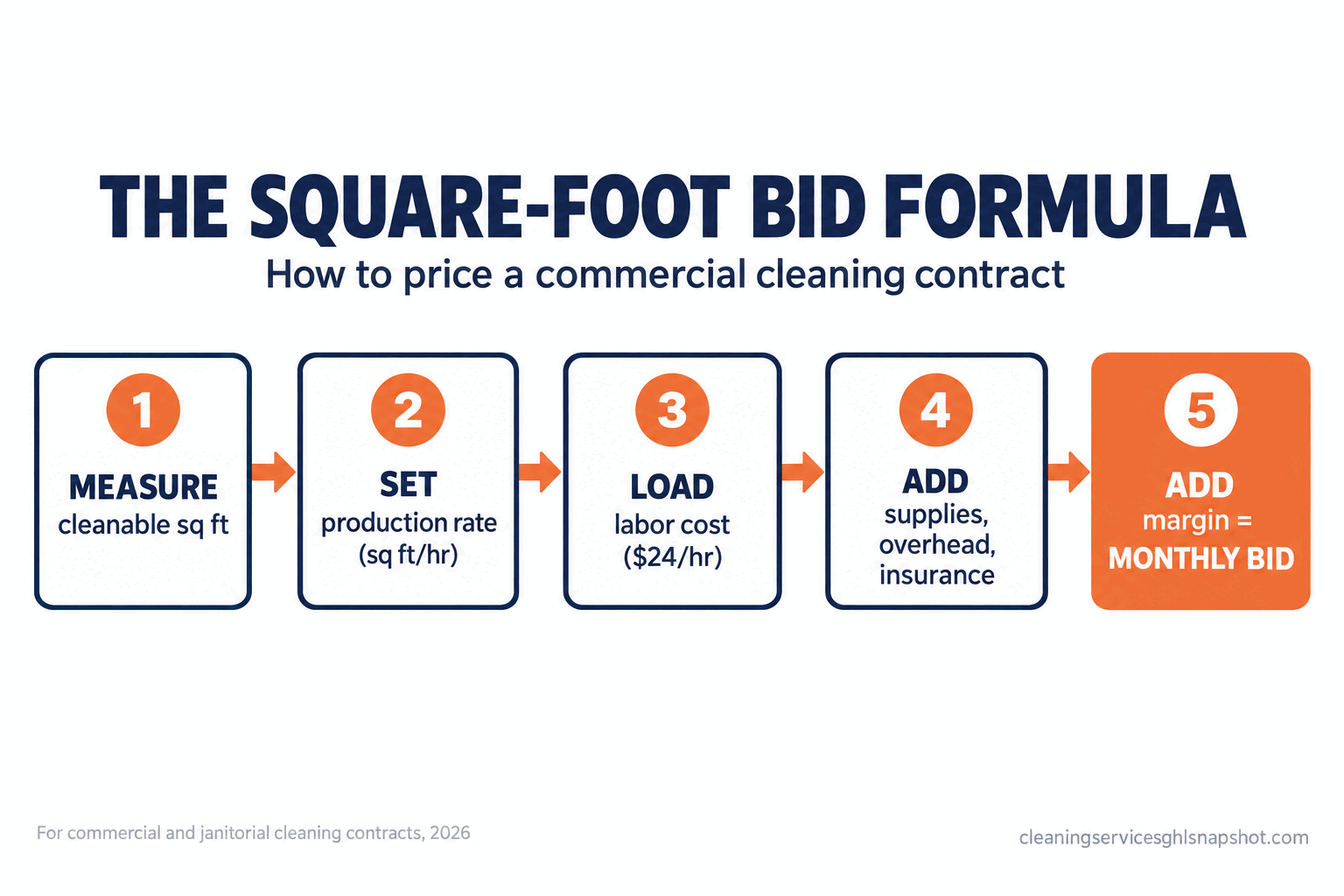
Here is the short version: a commercial cleaning bid is a cost calculation with a margin on top, not a number you pull from a competitor’s quote. You measure the real cleanable square footage, pick a production rate, turn it into labor hours, load the true cost of those hours, add supplies, overhead, and insurance, then add a margin and check the result against the market. Skip a step and you either lose the bid or win it and lose money every month for a year. This post hands you the formula, a copy-paste worksheet, three worked bids, the compliance traps that change the math, and the mistakes that quietly turn a signed contract into a loser.
I run a small agency that builds systems for home-service operators, and more cleaning owners than I can count have shown me a commercial contract they regret. They quoted fast to beat another company, matched a price per square foot they saw online, never did the labor math, and eight months later the account is their biggest headache and their thinnest margin. The commercial side is worth getting right: the US janitorial services industry runs about $112 billion a year across roughly one million businesses (IBISWorld, 2026). The money is there; the trap is bidding like it is a guess. Every figure below is sourced.
Sources: IBISWorld Janitorial Services (2026); O*NET / BLS OEWS wages for janitors, May 2025; ISSA commercial cleaning rates; Insureon cleaning insurance cost.
Key Takeaways
- Bid from cost, then check the market. Labor hours drive the price; the market only tells you if you are in range.
- Measure cleanable square footage, not gross. Walls, shafts, and mechanical rooms are not floor you clean.
- Your production rate is the whole ballgame. Square feet one cleaner covers per hour decides your labor cost. Time it; do not guess.
- Load the labor cost. Payroll taxes, workers’ comp, and paid drive time push a $17.71 wage past $24 an hour before you earn a dollar.
- Per-foot price falls as buildings grow, and periodics are separate. One rate misbids every building; strip-and-wax and window work are their own line items.
Table of contents
- Why one bad bid haunts you for a year
- The square-foot bid formula, step by step
- Step 1: Measure the real cleanable square footage
- Step 2: Set your production rate
- Step 3: Load your true labor cost
- Step 4: Add supplies, overhead, insurance, and bond
- Step 5: Add margin and check the market
- Steal this: the commercial bid worksheet
- Three worked bids: small, mid, and large
- The compliance that changes your numbers
- Failure modes that turn a win into a loss
- Objections, answered straight
- Frequently asked questions
Why one bad bid haunts you for a year
It is a Tuesday and a property manager emails you a floor plan for a 22,000 square foot office. She needs a monthly number by Friday, and she mentions that the current vendor charges “around eight cents a foot.” You want the account, so you do the quick math, land near her number, and send it. You win.
Then the real cost shows up. The restrooms take longer than you guessed and the break room is a disaster every morning. Your crew needs three and a half hours a night, not the two you assumed, and you pay them whether you estimated right or not. By spring the account you fought for is the one you dread, and the contract locked your price for twelve months.
That is the problem with pricing off someone else’s number. A commercial contract is a monthly promise to spend a fixed amount of labor, so the bid has to start from the labor, not a per-foot figure from a forum.
The square-foot bid formula, step by step
Every profitable janitorial bid, from a one-room suite to a hospital, comes from the same five inputs:
- Cleanable square footage. The floor your crew actually touches.
- Production rate. Square feet one cleaner covers per hour, set by facility and scope.
- Loaded labor cost. The real cost of a crew-hour, not the wage.
- Supplies, overhead, insurance, and bond. Everything that is not direct labor.
- Margin. The profit you build in on top of cost.
The arithmetic is simple: square footage divided by production rate gives labor hours, times visits and loaded labor cost gives your labor spend, plus supplies and overhead gives total cost, and total cost divided by (1 minus your margin) gives the price. The steps below show each input. Miss any one and the number is wrong.
Step 1: Measure the real cleanable square footage
Buildings are leased by gross square footage, which includes walls, shafts, stairwells, and mechanical rooms your crew never cleans. Cleanable square footage is smaller, usually 80 to 90 percent of gross for an office, and it is the only number that belongs in your bid.
Walk the space with the floor plan and a measuring wheel, and split the area by surface type, because carpet, hard floor, and restroom tile clean at different speeds. Never bid an account you have not walked. The time you quote off a floor plan alone is the time the “office” turns out to be a machine shop with a mezzanine.
Step 2: Set your production rate
Your production rate is how many square feet one cleaner finishes in an hour. It is the single biggest lever in the bid, and there is no universal number. Guidance ranges from about 1,000 square feet an hour for neglected or detail-heavy space up to 4,500 to 6,000 for large open Class A and B offices, where a worker has to hit that pace to stay competitive (CleanLink). A basic office lands in the middle.
To set it, time it, which is what the trade bodies teach. The International Sanitary Supply Association publishes task-level cleaning times and a simple conversion: clean a measured test area, divide 60 by your minutes, and multiply by 1,000 for square feet per hour. Do that in a few buildings and you will trust your own rates over any chart. Lean conservative when unsure.
Illustrative one-cleaner production rates, square feet per hour, by facility type and scope. Time your own buildings to confirm. Source range: CleanLink, ISSA cleaning times.
Step 3: Load your true labor cost
The wage is what cleaners get paid, not what a crew-hour costs you. The median janitor earns about $17.71 an hour nationally, with the bottom ten percent near $13.77 and the top ten percent around $24.17 (BLS OEWS, May 2025, via O*NET; overview at BLS). On top of the wage you pay the employer share of payroll taxes, workers’ compensation, paid travel between sites, and a share of paid time off. Those add roughly 30 to 45 percent, so a $17.71 wage is really $23 to $26 a crew-hour before you earn anything.
Use your real loaded number. If you have not built it, the true cost-per-clean breakdown walks the whole stack, and paying crews as 1099 contractors to dodge those costs is the trap in the 1099 versus W2 guide.
Step 4: Add supplies, overhead, insurance, and bond
A profitable bid carries more than direct labor:
- Supplies. Chemicals, liners, paper, and restroom consumables, often 4 to 7 percent of labor.
- Equipment. Vacuums, auto-scrubbers, and floor machines wear out. Spread their cost across the contracts that use them.
- Insurance and bonding. Most clients ask for a certificate of insurance before you set foot in the building. General liability for a cleaning business commonly runs around $50 a month at $1 million per occurrence and $2 million aggregate, though 2026 estimates range higher for janitorial work (Insureon, MoneyGeek). A janitorial bond, which reimburses the client if an employee steals, runs about $9 to $11 a month and is usually a contract requirement, not a law (Insureon).
- Overhead. Admin time, software, fuel, and the slice of your own salary this account should carry.
Allocate a realistic share of each, and do not let a fixed-percentage shortcut hide a large one-off cost like a floor machine bought for one account.
Step 5: Add margin and check the market
Build profit into the price, do not bolt it on. For a 30 percent margin on $4,000 of cost, you do not add 30 percent; you divide $4,000 by 0.70, which is about $5,715. Smaller accounts can carry 30 to 40 percent; large contracts compress to 15 to 25 percent as volume and competition squeeze the rate.
Now check the market. Benchmarks put general office cleaning around $0.09 to $0.17 per square foot (ISSA), with IBISWorld citing a broader $0.31 figure across facility types (IBISWorld), and medical or specialty space higher. Monthly, that often looks like $1,200 to $6,500 for buildings between 5,000 and 25,000 square feet (HomeStars). If your price lands far outside the range, your rate or scope is off. Inside it, you can bid knowing you are competitive and profitable.
One warning trips up more operators than any other: published per-square-foot figures are wildly inconsistent about whether they mean per visit or per month. Always attach the unit to your own rate, and when a client quotes “eight cents a foot,” ask per what before you react.
Steal this: the commercial bid worksheet
Fill this in for every bid. It is the whole formula in order.
The walkthrough is where you catch the surprises that blow a bid. Ask these before you quote.
The last two questions are where free work hides. Nail them down, then put the scope in writing. The cleaning service contract template has the scope-of-work language that keeps “while you’re here” requests from becoming unpaid jobs.
Three worked bids: small, mid, and large
The same formula at three sizes, illustrative, with a loaded labor cost of $24 an hour and the production rates from Step 2.
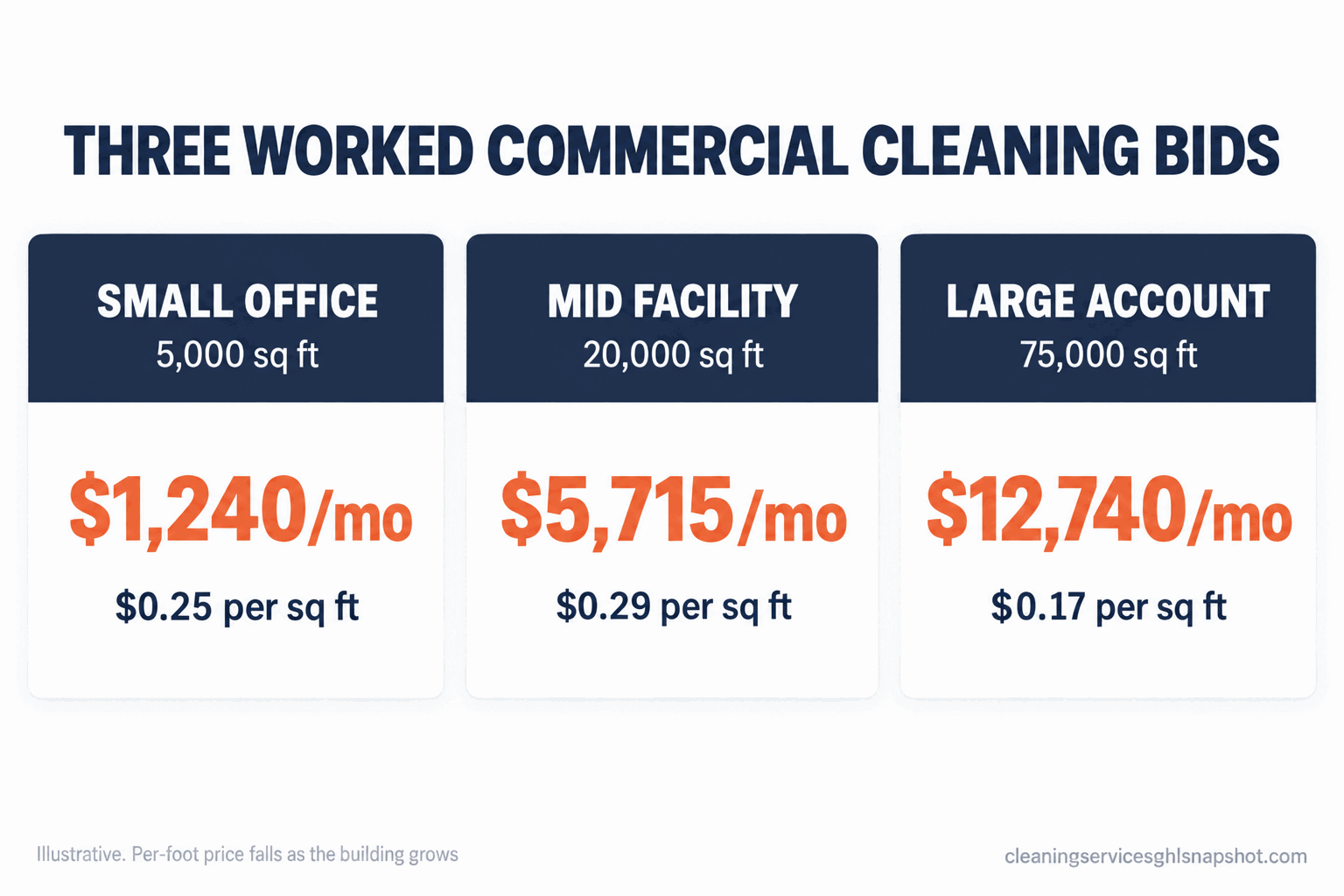
| Input | Small office | Mid facility | Large account |
|---|---|---|---|
| Size and frequency | 5,000 sq ft, 3 nights | 20,000 sq ft, 5 nights | 75,000 sq ft, 5 nights |
| Production rate | 2,500 sq ft/hr | 3,000 sq ft/hr | 4,500 sq ft/hr |
| Monthly labor hours | 26 | ~145 | ~362 |
| Monthly labor at $24/hr | $624 | $3,480 | $8,690 |
| Supplies + overhead | $180 | $520 | $1,500 |
| Total monthly cost | $804 | $4,000 | $10,190 |
| Target margin | 35% | 30% | 20% |
| Monthly price | ~$1,240 | ~$5,715 | ~$12,740 |
| Per sq ft / month | $0.25 | $0.29 | $0.17 |
Illustrative. Small spaces use a lower rate (setup and travel eat a bigger share); large open areas clean faster; margins compress at scale.
Notice the per-foot rate: $0.25, then $0.29, then $0.17. It falls as the building grows, because the large account spreads fixed overhead wide and cleans faster. One rate applied to every building overprices some and underprices others, so run the formula each time.
The compliance that changes your numbers
Two rules can move a bid.
Worker classification. Paying crews as 1099 contractors to skip payroll taxes and workers’ comp makes a bid look cheap and is the fastest way to a back-tax bill. Most cleaning crews fail the tests for contractor status because you control their schedule, methods, and tools, and strict ABC-test states presume employee. Bid on 1099 costs, reclassify later, and your real cost jumps about 30 percent overnight with the quoted margin gone. Price employees from the start. The 1099 versus W2 breakdown covers the tests and the numbers.
Texting consent. The moment you text a client’s facility manager or your crew through an automated system, you are in A2P 10DLC and TCPA territory, where carriers require registered campaigns and getting consent wrong can block your number mid-contract. The TCPA and 10DLC guide for cleaners has the consent language and registration steps.
Failure modes that turn a win into a loss
This is the section nobody writes, and it is the one that saves the contract.
You bid the gross square footage. Billing walls and shafts as cleanable floor inflates your hours, and you lose to someone who measured net.
You guessed the production rate. The most expensive error by far. Assume 3,500 when the truth is 2,500 and you under-bid labor by 40 percent, every visit, for a year. Time it instead.
You used the wage, not the loaded cost. A bid built on $17.71 when your real crew-hour is $24 loses a quarter of its labor margin before supplies.
You buried the periodics in the recurring rate. Strip-and-wax, carpet extraction, high dusting, and window cleaning are separate line items, not freebies inside the nightly price.
You matched a competitor’s per-foot price blind. Their building, scope, and frequency are not yours, and you do not know if their number is per visit or per month. Sanity check at the end, never start there.
You locked a flat price with no escalator and never automated the back office. A multi-year contract with no annual increase lets wage inflation eat your margin by month six, and chasing the invoice and texting the crew by hand is unpriced labor of your own. Build in a yearly adjustment and systematize the admin, as in the get-paid-automatically playbook.
Objections, answered straight
“This is too much math. The last vendor just quoted a number.” And plenty of those vendors are stuck with contracts they hate. The math is a spreadsheet you fill in once, and twenty minutes of it beats a year of a losing contract.
“The client already told me the budget, so why not just hit it?” Hit it only if your formula says you can profit there. If the budget is below your cost, a thinner scope or fewer visits might fit. Signing below cost to win the logo is how operators go broke with a full schedule.
“My market is cheaper than these rates.” Then your production rates and wages are different too, and the formula still works. The method does not care what your market pays; it tells you whether this bid makes money.
The bottom line
A commercial cleaning bid is a cost you can calculate, not a number you guess. Measure the real floor, set an honest production rate, load the labor, add every cost, build in the margin, then check the market last. Do that and the contracts you win are ones you are glad you signed.
Go back to that Tuesday floor plan and the “eight cents a foot.” The version of you with the worksheet walks the building, finds the restrooms are heavy, and prices three and a half hours a night, not two. The number comes out above the old vendor’s and you win anyway, because you show up with a scope in writing and a crew paid for the hours the job takes. Same account, different year.
How do you price a commercial cleaning contract?
Price from cost, then check the market. Measure the cleanable square footage, set a production rate (square feet one cleaner covers per hour), divide for labor hours per visit, multiply by visits per month and your loaded labor cost for monthly labor, add supplies, equipment, insurance, bond, and overhead for total cost, then divide total cost by (1 minus your margin) for the monthly price. Compare that price per square foot to the market.
What is the average cost per square foot for commercial cleaning in 2026?
General office cleaning commonly runs about $0.09 to $0.17 per square foot per ISSA, with IBISWorld citing a broader $0.31 benchmark across facility types and medical or specialty space higher. Monthly, that often looks like $1,200 to $6,500 for buildings between 5,000 and 25,000 square feet. Published figures mix per-visit and per-month, so confirm the unit before you compare.
What production rate should I use for an office?
There is no universal number. Guidance ranges from about 1,000 square feet an hour for detail-heavy or neglected space to 4,500 to 6,000 for large open offices, with a standard office near 2,500 to 3,500. The reliable method is to time a measured test area: divide 60 by your minutes and multiply by 1,000 to get square feet per hour. And bid on your loaded crew-hour cost (wage plus payroll taxes, workers' comp, and paid travel, roughly $23 to $26 on a $17.71 wage), never the wage alone.
Should I bid on 1099 contractors to keep my price low?
It is risky. Most cleaning crews fail the tests for independent-contractor status because you control their schedule, methods, and tools, and strict ABC-test states presume employee. Bid on 1099 costs and later reclassify, and your real cost jumps about 30 percent with the quoted margin gone, on top of possible back taxes and penalties. Price employees from the start.
Should periodic work like floor stripping be in the monthly rate?
No. Strip-and-wax, carpet extraction, high dusting, and window cleaning are separate line items with their own prices and schedule, not part of the nightly recurring rate. Rolling them in gives away expensive specialty work for free. Quote periodics as scheduled add-ons, and build an annual escalator into multi-year contracts so wage growth does not erode your margin.