
It is 6:40 on a Sunday evening and Rosa texts to say she is not coming back. That is the second cleaner this month, and you have eleven houses on Monday with four people to clean them. Your job ad has been live nine days and produced three applicants: one never returned your voicemail, one agreed to an interview and never showed, and one accepted the job then vanished before her first morning.
So you load the van yourself and tell yourself nobody wants to work anymore.
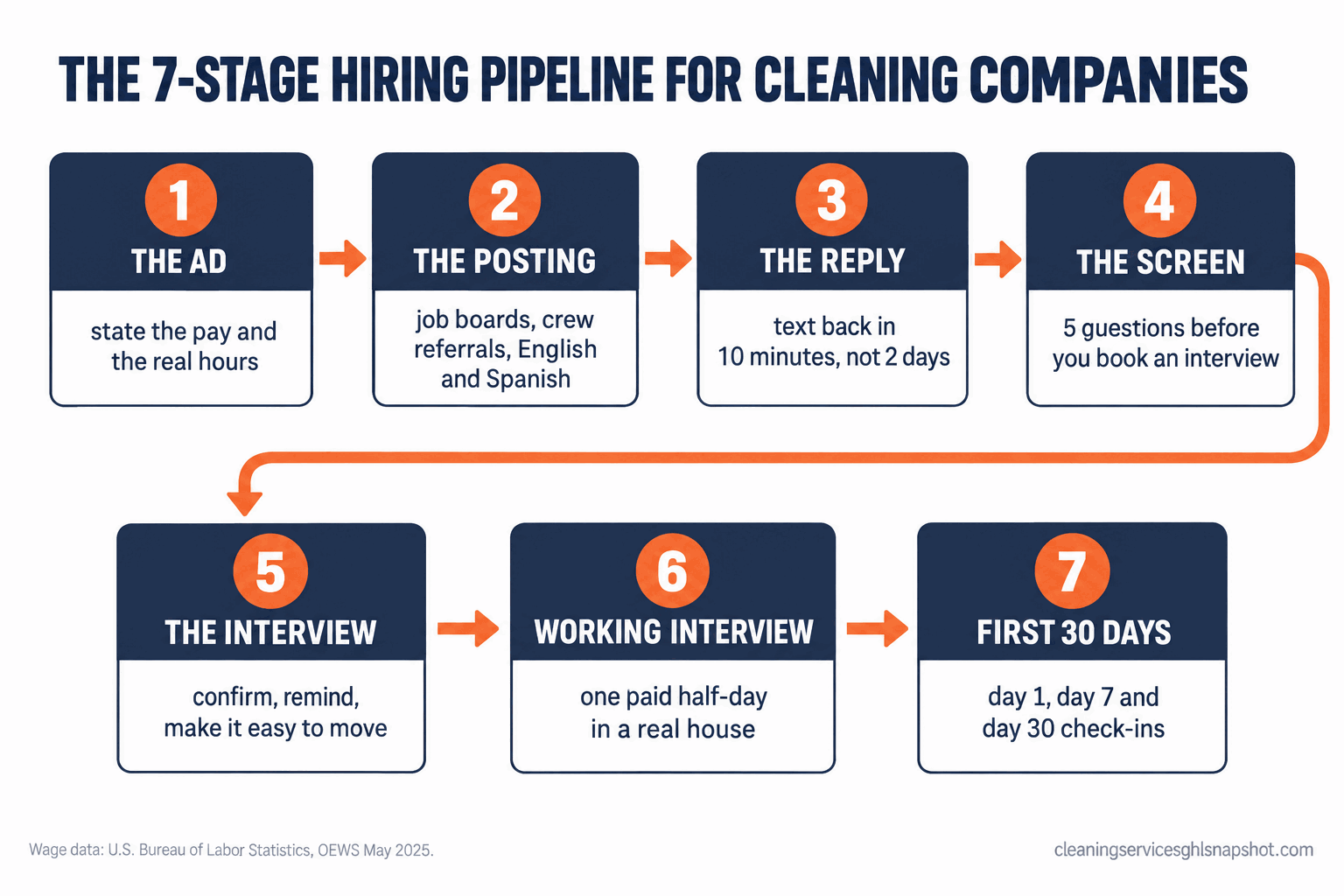
That is not what is happening. You have a hiring pipeline with seven stages in it and you are running two: post an ad, then hope. Operators who fill a seat in a week answer applicants in minutes, screen hard before spending an hour interviewing, and treat the first thirty days as part of the hire. Here is that system.
Key Takeaways
- The churn is the market, not your bad luck. The occupation is projected to grow 2% from 2025 to 2035 yet averages about 321,800 openings a year, nearly all replacing people who left (BLS).
- Know the wage ladder before you post. Median pay was $17.07 an hour in May 2025, the 25th percentile $14.59, the 75th $19.03 (BLS OEWS). Advertise $14 and you are fishing below the middle of the market.
- Speed beats everything else. Whoever gets into a real conversation first usually gets the hire.
- The working interview is the real screen. One paid half-day beats three sit-down interviews.
- Decide classification before you offer. Cleaners doing your scheduled work with your supplies look like employees under both federal and state tests (DOL).
Table of contents
- What an empty seat costs you
- The pipeline, start to finish
- Stage 1: The ad that filters
- Stage 2: Posting where cleaners look
- Stage 3: The ten-minute reply
- Stage 4: Five questions that save an hour
- Stage 5: The interview people attend
- Stage 6: The paid working interview
- Stage 7: The first thirty days
- The same pipeline at three sizes
- Settle the 1099 question first
- The objections I hear
- Frequently asked questions
- The bottom line
What an empty seat costs you
Most hiring problems are pricing problems in disguise. Here is what the market actually paid cleaners in May 2025.
Hourly wages for maids and housekeeping cleaners, United States, May 2025. Source: U.S. Bureau of Labor Statistics, OEWS.
Read that as a map of who you can reach. Advertise $13.50 and you compete for the bottom tenth of the pool, the slice with the least experience and the most churn. Advertise $19 and you are at the 75th percentile, where you get to be picky. Across a 30-hour week that gap is about $165, which one recurring biweekly house covers.
Now price the empty seat. A cleaner doing two homes a day at $150 brings in roughly $300 daily, so four days is $1,200 that does not happen while the seat sits open. Six weeks of that is about $7,200 you never billed, more than a year of the wage gap that would have filled it. The labor math is in our cost-per-clean breakdown.
The pipeline, start to finish
Seven stages. Most operators run Stage 1 and Stage 5 and skip the rest, which is why the funnel leaks.
| Stage | Where it leaks |
|---|---|
| 1. The ad | Vague pay, generic duties |
| 2. The posting | One board, English only |
| 3. The reply | Voicemail, 2-day callbacks |
| 4. The screen | Interviewing everyone |
| 5. The interview | No reminders, no-shows |
| 6. The working interview | Hiring off a conversation |
| 7. The first 30 days | Trial by fire, then quit |
Stage 1: The ad that filters
Most cleaning ads are written to appeal to everyone, so they tell nobody anything. “Join our growing team! Competitive pay! Must be reliable.” A good cleaner learns zero facts from that, applies to you and four others, and takes whoever calls first. A filtering ad states the pay, the real hours, and the non-negotiables, so the wrong people disqualify themselves before you speak.
How it breaks: hiding the pay to keep negotiating room, which only cuts applicant count. The second failure is a fantasy schedule. If your crews really finish at 6:00pm twice a week, say so, or you find out in week two when she quits and you are back at Stage 1 having paid to train her.
Stage 2: Posting where cleaners look
Indeed and Facebook cover most of your volume, but the hires that stay come from somewhere warmer: referrals from your current cleaners, local Facebook groups, community and church boards, and English-and-Spanish versions of the same ad.
Pay for referrals in real money. A $200 bonus, half at thirty days and half at ninety, costs less than three weeks of an open seat, and your crew pre-screens for you because nobody recommends someone who will embarrass them.
How it breaks: posting once and letting it sit, since board visibility decays. The other failure is posting only in English where much of the available workforce is more comfortable in Spanish. In many cities that is most of your pond.
Stage 3: The ten-minute reply
This stage costs the most and takes the least effort to fix. A cleaner applies to several companies in one sitting, and whoever gets into a real conversation first gets the interview, because job hunting is exhausting and she stops looking as soon as something lands. You are probably in a house with your hands full when that application arrives, so the reply cannot depend on you.
It comes from a named human, not “the hiring team,” and asks for a reply that takes thirty seconds. People answer texts. They do not answer voicemail.
How it breaks: sending it from a personal cell, so you lose the history and any record of what was promised about pay. Texting applicants also puts you under the same carrier rules as texting customers, so that number has to be 10DLC registered or your messages get quietly filtered. See our TCPA and 10DLC guide.
Stage 4: Five questions that save an hour
An interview costs forty-five minutes plus the context switch. A screen costs four texts. Run it before you book anything, and listen for specifics rather than enthusiasm.
- “Walk me through how you would clean a bathroom, start to finish.” Someone who has done this says top to bottom, dry before wet, toilet last. Someone who has not says “I’d make sure it’s really clean.”
- “What time would you leave home to reach our shop by 8:00?” A transportation question disguised as a scheduling one. It surfaces the two-bus-transfer problem before day one.
- “Tell me about the last job you left and why.” Listen for whether the reason is something your shop also does.
- “Are you okay with us running a background check?” Ask early. The ones who will be a problem go quiet right here.
- “What do you need to earn a week for this to be worth it?” If the honest answer is above your range, you just saved an hour.
How it breaks: turning the screen into a second interview, or ignoring what you hear because you are desperate. A seat filled with the wrong person is open again in five weeks, except now you have paid to train them and absorbed the customer complaints. That is how operators end up with the quality problems in why cleaning customers complain.
Stage 5: The interview people attend
Interview no-shows are mostly not rudeness. They happen when someone accepts a time, hears nothing for four days, gets a firm offer elsewhere, and does not want the awkward cancellation call. Fix it the way you already stop customers forgetting a clean: confirm, remind, make it easy to move.
That last message is the one operators skip, and it recovers more interviews than anything else here, because “running late is not a problem” removes the shame that causes the ghosting.
How it breaks: scheduling the interview six days out, which gives a competitor time to hire her. Book within 48 hours. The other failure is reminders from a number that cannot receive replies, which turns a reschedule into a no-show.
Stage 6: The paid working interview
You cannot tell who cleans well by talking to them. You can tell in ninety minutes of watching them clean. Pay for a half-day, send them out with your best crew lead, and give them real work in a real house with a customer who has agreed to it.
Watch three things. Does she work in a system, or wander room to room touching whatever catches her eye? Does she ask when something is unclear, or guess and hope? And what does the crew lead say afterward, which is the most accurate read you will get all week.
Pay for the time, always. Productive work in a customer’s home is compensable under the Fair Labor Standards Act, so an unpaid tryout creates real exposure to save about $70.
How it breaks: sending them with whoever is free, so your weakest lead teaches her your worst habits on day one. The other failure is skipping the stage because you are short-staffed, which is exactly when your judgment is worst.
Stage 7: The first thirty days
Most cleaning hires who quit do it in the first month, and rarely over money. They quit because nobody told them where to park, they felt stupid for a week, and nobody noticed they existed. Four scheduled messages fix most of that.
How it breaks: the owner sends day one then goes quiet, which reads as interest that ran out. Put all four on a schedule. And when someone answers day seven honestly, fix the thing, or you have taught them that feedback goes nowhere. The deeper version is why your cleaning crew keeps quitting.
The same pipeline at three sizes
The seven stages do not change. Who runs them does.
Solo operator or one crew. Automate Stage 3 and Stage 5 completely, because those are the two that fail when you are in a house all day. Hire one person before you think you need them, because at your size one departure is a crisis.
Mid-size residential, three to eight crews. You are hiring continuously, so stop treating it as an emergency: ad always live, screen always running, a bench of two or three people you liked but did not need yet. Hand Stages 3 through 5 to an office manager and keep the working interview.
Large residential or janitorial, fifteen to fifty-plus. Night work, bonding, and insurance narrow the pool, so the pipeline runs weeks ahead of need and the background check is a documented process, not a judgment call. Classification exposure scales too: fifty misclassified workers is not fifty times one problem, it is an audit.
Settle the 1099 question first
This is the part operators most want to skip, and the one that writes the biggest checks.
The federal test is genuinely in flux. The Department of Labor’s 2024 independent contractor rule took effect in March 2024, but in May 2025 the agency told its investigators to stop applying it and return to the earlier economic reality analysis (Field Assistance Bulletin 2025-1), then proposed replacing the rule outright in February 2026. The 2024 rule still shapes private lawsuits even where DOL is not enforcing it (DOL guidance).
What does not change: if you set the schedule, supply the equipment, decide the method, and the person works only for you, that is an employee under every version of the test anyone has proposed. A signed agreement saying otherwise does not change it.
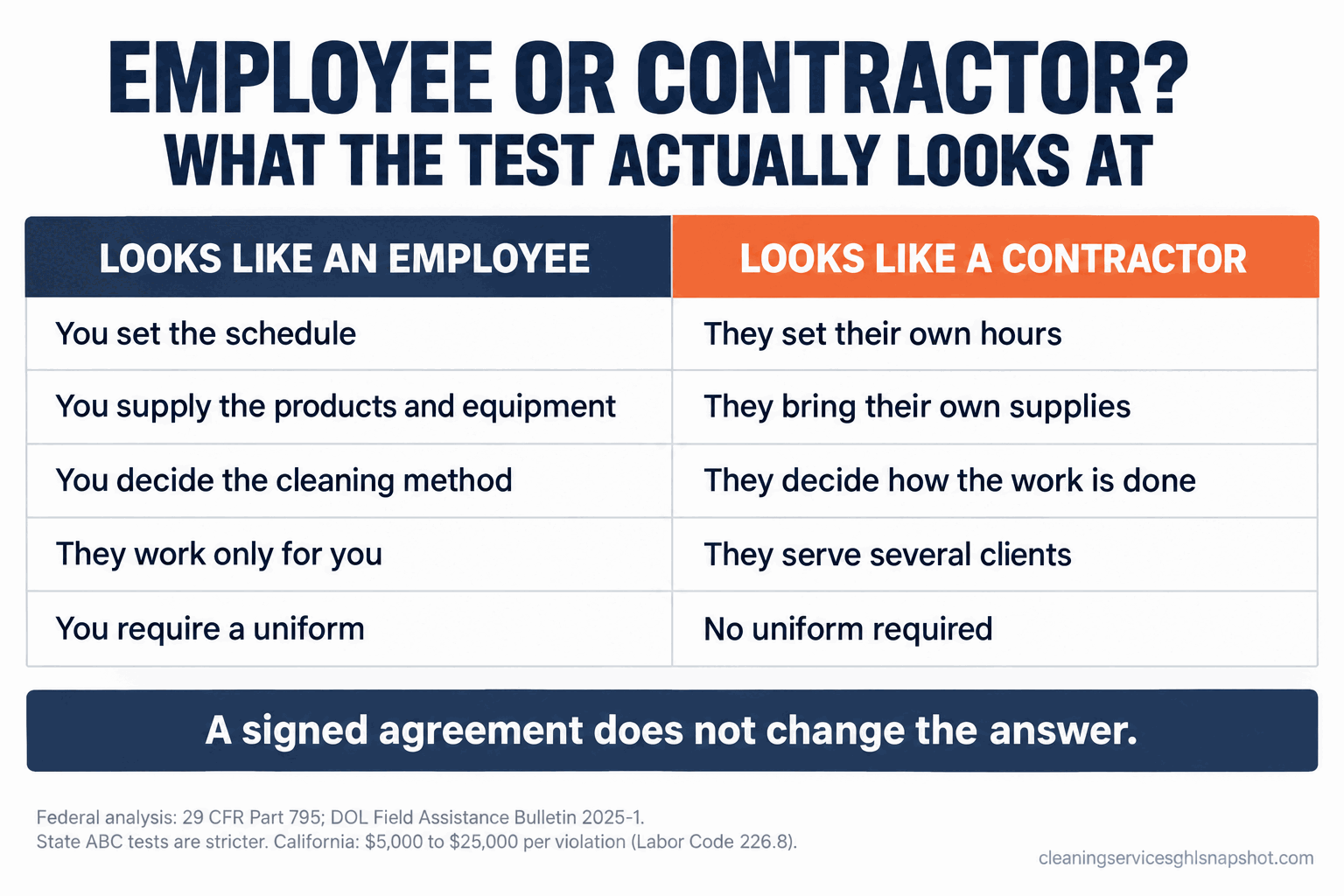
Decide before you post the ad, because it changes the pay number and the offer. Converting someone from contractor to employee three months in, after they have told their friends what you pay, is the worst version of this.
The objections I hear
“I can’t afford to pay $18 an hour.” Run the other number. Six weeks with a seat open costs roughly $7,200 in billable work. The difference between $15 and $18 across a 30-hour week is $90. If the math genuinely fails at market wage, the problem is your pricing, and that is a cost-per-clean conversation.
“I’ve hired six people this year and they all left.” Then your problem is Stage 7, not Stages 1 through 6, and hiring faster into a shop people leave just means churning more efficiently. Check your thirty-day retention before you spend another dollar on ads.
“Everyone in cleaning uses 1099, that’s just how it works.” It is common and frequently wrong, which is a bad combination when the penalty is calculated per worker and per pay period. Common practice is not a defense in an audit.
“I don’t have time to run seven stages.” You already run them, slowly and by hand, which is why they fail. Three of the seven are messages that should fire on a trigger with you nowhere near your phone.
Frequently asked questions
How much should I pay cleaners in 2026?
The May 2025 national median for maids and housekeeping cleaners was $17.07 an hour, with the 25th percentile at $14.59 and the 75th at $19.03 (BLS OEWS). Paying at or just above the median gets a real applicant pool. Adjust for local cost of living and your state minimum wage, which sets the floor.
Where is the best place to post a cleaning job ad?
Indeed and local Facebook groups produce the most volume, but referrals from your own crew produce the best retention, because the person already knows what the job really is. Pay around $200, split between day 30 and day 90, and post in both English and Spanish in most US markets.
Should I hire cleaners as 1099 contractors or W2 employees?
If you set their schedule, provide supplies and equipment, dictate the cleaning method, and they work only for you, they are employees under both the federal economic reality analysis and the stricter state ABC tests. No version of the rule now being debated would make a scheduled, supplied, supervised house cleaner a contractor.
How do I stop applicants from ghosting the interview?
Shorten the gap and add reminders. Book within 48 hours of the screen, confirm at booking, remind the evening before asking for a one-word reply, and remind again two hours out. Then send a no-pressure message the same day if they miss it.
How long should it take to fill a cleaning position?
Roughly 7 to 10 days from application to first day is realistic: screen within a day, interview within 48 hours, run the working interview that week, start the following Monday. If you are routinely past three weeks, the leak is almost always Stage 3, the speed of your first reply.
The bottom line
Back to that Sunday evening. Run this pipeline and Rosa’s text lands differently. The ad is already live with the pay in the headline, two people you screened last month are on the bench, and Monday’s applicant gets a reply in ten minutes instead of Thursday, interviews Tuesday, cleans a paid half-day Wednesday, and starts the following Monday.
None of that required paying above market or finding a secret job board. It required answering people quickly, screening honestly, watching them clean before committing, and paying attention for their first month. Build it once and it runs whether or not you have time this week.