
For a cleaning business website in 2026, Astro beats WordPress on the two things that actually decide whether a visitor becomes a booking: page speed and search visibility. Astro ships static-first HTML with almost no JavaScript, so a well-built cleaning site loads in under a second and clears Google’s Core Web Vitals with room to spare. A typical WordPress site — a theme plus a stack of plugins for booking, forms, sliders, and SEO — carries so much overhead that hitting a 90+ PageSpeed score becomes a constant fight. That gap isn’t cosmetic. 53% of mobile visitors abandon a page that takes longer than 3 seconds to load (Think with Google), and for a local service where most searches happen on a phone, every one of those bounces is a job that went to the cleaner whose site opened first.
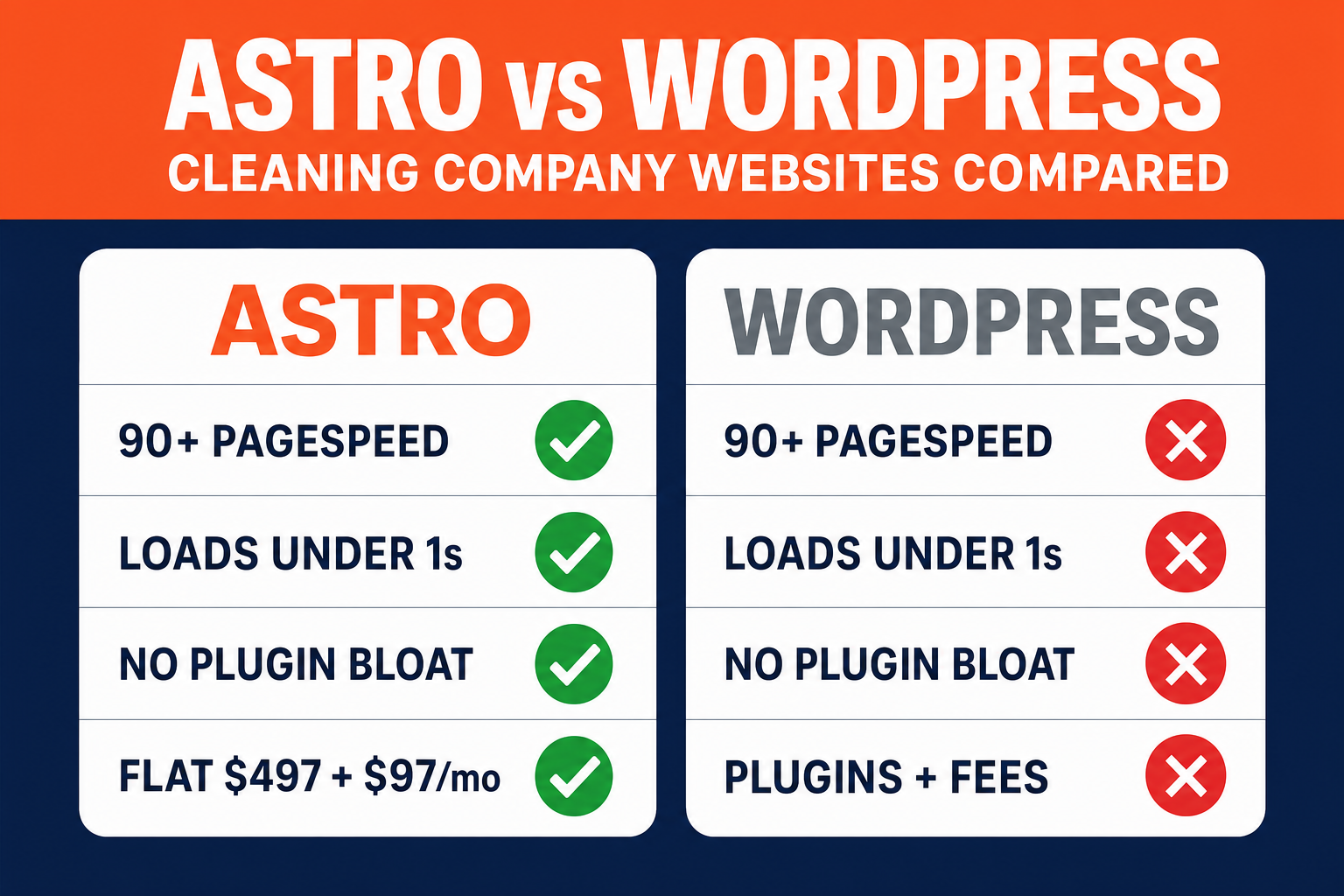
This isn’t a knock on WordPress as software — it runs a huge share of the web and it’s endlessly flexible. But “flexible” and “fast for a small local business to keep fast” are different promises. This guide compares the two head-to-head for a cleaning company specifically: the real speed and Core Web Vitals data, what it costs to book a job, SEO and local search, how easy each is to actually update, and where a done-for-you Astro build fits. The numbers below are all sourced — no invented figures.
Key Takeaways
- Speed is a revenue lever, not a vanity metric. Deloitte found a mere 0.1-second improvement in mobile load time lifted retail conversions 8.4% and average order value 9.2% (web.dev / Deloitte). For a cleaning site, faster pages mean more quote-form completions.
- Astro is built to be fast by default. It ships zero JavaScript unless you ask for it and renders static HTML at the edge, so a cleaning site routinely loads in under a second and passes Core Web Vitals — the good LCP threshold is under 2.5 seconds (Google).
- WordPress speed erodes over time. The median web page is now 2.56 MB on mobile with ~697 KB of JavaScript (HTTP Archive 2025); every booking, slider, and SEO plugin you add pushes a WordPress site further past that.
- Local search is mostly mobile and impatient. 76% of people who run a “near me” search on a phone visit a business within a day (Backlinko) — they won’t wait for a slow page.
- Cost is predictable with a managed Astro build. A done-for-you cleaning site is a flat $497 one-time + $97/month (Get a Website) — no plugin licenses, no surprise “the site broke after an update” invoices.
Table of contents
- Why website speed decides how many jobs you book
- Astro vs WordPress: the head-to-head
- Page speed and Core Web Vitals, compared
- SEO and local search: which ranks a cleaning company better
- Editing, maintenance, and security
- What it actually costs to book a job
- When WordPress still makes sense
- How to get a fast cleaning website without building it yourself
- Frequently asked questions
Why website speed decides how many jobs you book
A cleaning company website has one job: turn a stranger who searched “house cleaning near me” into a booked quote. Everything upstream — your Google ranking, your ads, your Google Business Profile — just delivers a visitor to the page. If the page is slow, you lose them before they ever see your price or your reviews.
The data here is unusually consistent. Google’s mobile benchmark research found that 53% of visits are abandoned when a mobile page takes longer than 3 seconds to load (Think with Google). Deloitte’s “Milliseconds Make Millions” study, which analyzed mobile data from dozens of brands, found that improving load time by just 0.1 seconds increased retail conversion rates by 8.4% and average order value by 9.2% (web.dev). And Portent’s analysis of over 100 million page views found that a site loading in 1 second converts roughly 3× better than one loading in 5 seconds, with conversion dropping about 4.4% for every additional second in the critical 0–5 second window (Portent).
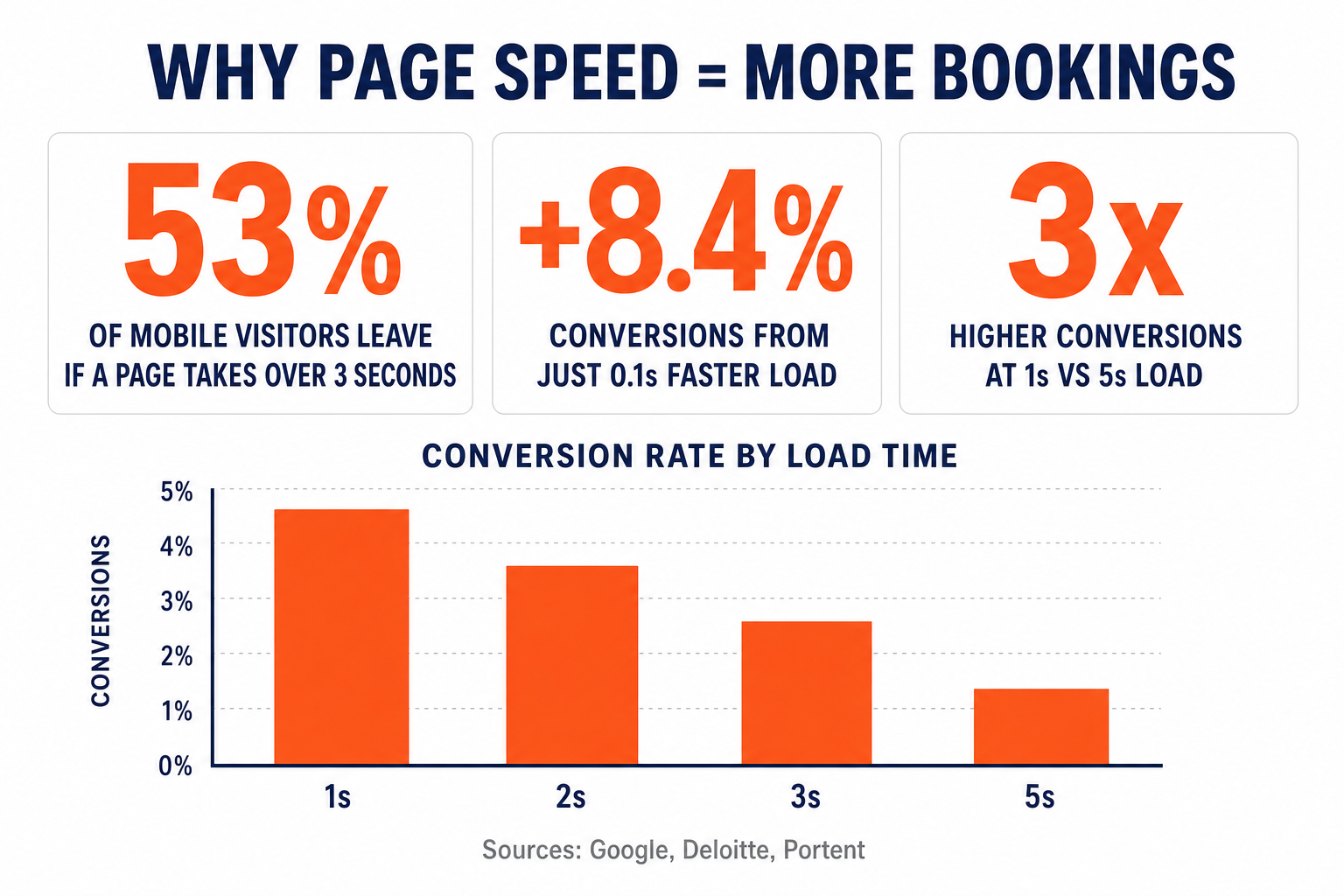
Relative conversion rate by page load time (a 1-second page indexed to 3× a 5-second page). Source: Portent, “Site Speed Is (Still) Impacting Your Conversion Rate.” Figures are directional across a large multi-site sample, not a guarantee for any single page.
For a cleaning operator, that curve is the whole ballgame. You’re not selling a $2,000 considered purchase where someone will tolerate a slow site — you’re competing to be the fast, easy option for a $175 recurring clean. The framework choice underneath your website is what makes speed either your default state or a permanent uphill battle.
Astro vs WordPress: the head-to-head
Here’s the honest side-by-side for a cleaning-business site. Both can produce a good-looking website; they differ sharply in what they cost you in speed, maintenance, and predictability.
| Factor | Astro (static-first) | WordPress (theme + plugins) |
|---|---|---|
| Default page speed | Ships near-zero JavaScript; sub-second loads are the norm | Fast bare, but plugins/themes add weight fast |
| 90+ Google PageSpeed | Routine, often 100 | Achievable but needs constant tuning/caching |
| Core Web Vitals | Passes easily (static HTML, small payload) | Frequently “needs improvement” once loaded up |
| Hosting | Global edge/CDN static hosting | PHP host + database; slower under load |
| Booking / quote forms | Built into the page, no plugin bloat | Usually a plugin (more scripts, more weight) |
| Security surface | Static files — almost nothing to hack | Plugins/themes/core need constant updates |
| Ongoing maintenance | Minimal; nothing to “break on update” | Plugin/theme/core updates, conflicts, backups |
| SEO control | Clean HTML, schema, meta fully controllable | Depends on an SEO plugin’s output |
| Typical cost | Flat build + managed monthly | Hosting + premium theme + plugin licenses |
The pattern is that WordPress’s flexibility is delivered through plugins, and plugins are exactly what erode speed, add a security surface, and create the “my site broke after an update” moments every cleaning owner has lived through. Astro moves that flexibility into the build step, so the thing that ships to your visitor is just fast, static HTML.
Page speed and Core Web Vitals, compared
Google measures real-world speed through Core Web Vitals, and it’s been a confirmed ranking signal since 2021. The three metrics are Largest Contentful Paint (LCP, loading), Interaction to Next Paint (INP, responsiveness), and Cumulative Layout Shift (CLS, visual stability). Google’s guidance: aim for LCP within 2.5 seconds, and all three passing at the 75th percentile to earn a “good” assessment (Google Search Central).
This is where the framework difference becomes concrete. The single biggest enemy of good Core Web Vitals is JavaScript weight — the browser has to download, parse, compile, and execute every script before the page is interactive. And the web has gotten heavier: the median mobile page in 2025 was 2.56 MB, carrying roughly 697 KB of JavaScript (HTTP Archive 2025 Web Almanac). A plugin-laden WordPress cleaning site tends to sit at or above that median. An Astro site ships almost none of it, because it renders the HTML ahead of time and only hydrates the few interactive bits (like a quote calculator) that genuinely need it.
Median 2025 web page weight and its JavaScript share — the payload a visitor’s phone must download before your site is usable. Source: HTTP Archive 2025 Web Almanac, Page Weight.
That’s why a done-for-you Astro cleaning site can guarantee a 90+ Google PageSpeed score — often a perfect 100 (Get a Website) on both mobile and desktop. It’s not a heroic optimization effort; it’s the default output of the framework. Getting the same result on WordPress means caching plugins, image optimization plugins, script deferral, and a good host — and re-checking it every time you add a feature.
SEO and local search: which ranks a cleaning company better
For a local cleaning business, SEO is mostly local SEO, and local search is overwhelmingly mobile and immediate. 76% of people who perform a “near me” search on a smartphone visit a related business within a day, and 88% within a week (Backlinko). Those searchers are ready to book now — and they judge you in the first few seconds of your page loading.
Speed feeds SEO in two ways. First, Core Web Vitals are a direct ranking input, so a faster site has a structural edge, especially as a tiebreaker between two cleaners with similar reviews and relevance. Second, and bigger, speed drives the engagement signals Google watches: a fast page keeps people from bouncing back to the results, which reads as a satisfied visit.
Beyond raw speed, Astro gives you cleaner control over the technical SEO that a cleaning company lives on:
- Location pages that actually rank. A page each for “office cleaning in [city],” “move-out cleaning in [suburb],” etc. — fast, hand-tuned titles and meta, no plugin deciding your output. This is the backbone of the local SEO playbook for cleaning businesses.
- Schema / structured data (LocalBusiness, Service, FAQ) injected correctly, which also helps you show up in Google’s AI Overviews and answer engines.
- A clean crawl. No plugin-generated bloat or duplicate URLs for Google to wade through.
WordPress can do all of this too — but it depends on an SEO plugin’s output and a theme that doesn’t fight you, and the fast, clean HTML is something you engineer rather than get for free.
Editing, maintenance, and security
The knock people raise against modern frameworks is “but WordPress is easy to edit myself.” In practice, for a cleaning business, the day-to-day editing you actually do — update a price, add a service, swap a photo, post a seasonal promo — is a support ticket either way. The difference is what happens around those edits.
On WordPress, you own the maintenance treadmill: core updates, theme updates, and plugin updates that periodically conflict, plus backups and a real security surface. WordPress’s popularity makes it the most-attacked CMS on the web, and the vulnerabilities overwhelmingly come from plugins and themes, not the core. A cleaning owner who’s on a job site all day is not going to babysit that — so it lapses, and lapsed updates are how sites get defaced or slowed to a crawl.
An Astro site is static files served from a CDN. There’s no database to breach on the front end and no plugin ecosystem to patch weekly. With a managed build, updates are a ticket you send, not a task you own — the prebuilt website approach means changes get made for you and the site simply stays fast and up.
What it actually costs to book a job
Cost only matters relative to what the site earns. A cleaning website exists to convert searchers into booked quotes, so the right question is “what does each path cost to reliably book jobs?”
A done-for-you Astro cleaning site is $497 one-time + $97/month, with hosting, domain, SSL, maintenance, and an instant-quote calculator included, and you pay only the monthly up front — the build fee is charged after the site is live and you’re happy (Get a Website). Add auto-blogging for $197/month total, or run up to five sites for multi-location operators and agencies at $1,200 + $297/month. It’s a predictable line item.
A DIY WordPress build has a lower sticker price and a higher true cost: premium theme, the plugin licenses above, managed hosting that can handle the load, and the time (or developer bills) to keep it fast and patched. When a slow or broken page is quietly losing you the 53% of mobile visitors who won’t wait, the “cheaper” option is frequently the expensive one.
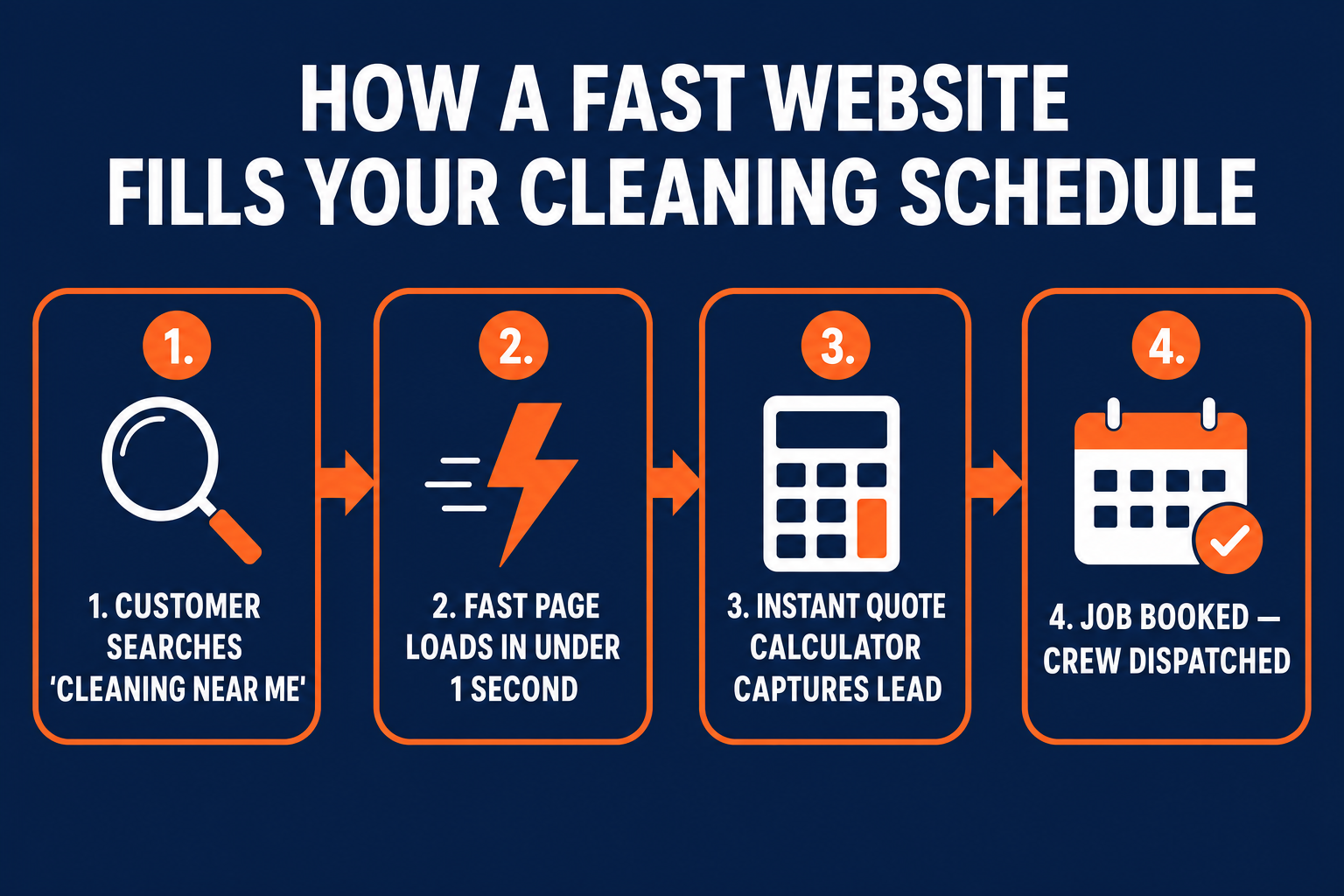
The fast path only works if the whole chain is fast: the page loads instantly, the instant-quote calculator captures the lead before they bounce, and the booking flows straight into your CRM and workflows so a crew gets dispatched. A framework that’s slow at step two quietly breaks steps three and four.
The cleaning clients who switch off a heavy WordPress site almost never miss the plugins. What they notice is that the phone starts ringing more — because the page finally loads before the visitor gives up and taps the next result.
When WordPress still makes sense
To be fair: WordPress is the right call in some cases. If you have a large editorial blog with many non-technical authors publishing daily, a deep membership or e-commerce operation with an established WooCommerce catalog, or an in-house team that already lives in WordPress and keeps it tuned and patched — its ecosystem is genuinely hard to beat.
But a typical cleaning company doesn’t need any of that. It needs a fast site, strong local pages, an instant quote, online booking, and reviews — a focused conversion tool that stays fast without a maintenance habit. For that job, static-first Astro is the better-fit tool, and it’s why we build cleaning sites on it.
How to get a fast cleaning website without building it yourself
You don’t have to learn Astro to benefit from it — that’s the point of a done-for-you build. Our Get a Website service ships a cleaning-specific Astro site with a guaranteed 90+ PageSpeed (often 100), location and service pages, LocalBusiness/Service/FAQ schema for SEO and AI Overviews, an instant-quote calculator, an AI chat widget, and managed Cloudflare hosting — for a flat $497 + $97/month, with the one-time fee charged only after you’re happy.
If you’d rather see it against your current site first, book a quick walkthrough and we’ll run your existing site’s PageSpeed and Core Web Vitals live, then show what a rebuilt version scores. Either way, the goal is the same: a site fast enough that the 53% of mobile searchers who won’t wait actually stick around and book.
Frequently asked questions
Is Astro really faster than WordPress for a cleaning website?
In practice, yes — for a small local business site. Astro renders static HTML ahead of time and ships almost no JavaScript, so pages routinely load in under a second and pass Google's Core Web Vitals (good LCP is under 2.5 seconds, per Google). A WordPress cleaning site can be fast, but the booking, form, slider, and SEO plugins a cleaning site needs each add JavaScript, and the median web page in 2025 already carried about 697 KB of it (HTTP Archive). Faster pages matter because 53% of mobile visitors abandon a page that takes over 3 seconds (Think with Google).
Will switching to an Astro site hurt my Google rankings?
Done right, it usually helps. Core Web Vitals are a confirmed ranking signal, and a faster site improves both that score and the engagement signals Google watches. The keys during a switch are keeping your URLs (or 301-redirecting them), preserving your titles, meta, and schema, and keeping your content — all of which a proper managed build handles. Because a cleaning business lives on local search, the faster site tends to convert more of the 76% of 'near me' searchers who visit a business within a day (Backlinko).
Can an Astro site still have online booking and a quote form?
Yes. Interactive pieces like an instant-quote calculator, a booking widget, and an AI chat widget are built into the site as lightweight components that load only where needed — you get the functionality without the plugin bloat that slows a WordPress site down. See how the instant quote versus callback approach captures leads before they bounce.
How much does a done-for-you cleaning website cost?
A single cleaning site is a flat $497 one-time plus $97/month, and you pay only the monthly up front — the $497 is charged after the site is live and you're happy. The monthly covers managed Cloudflare hosting, your domain, SSL, and maintenance. Auto-blogging is $197/month total, and multi-location operators or agencies can run up to five sites for $1,200 + $297/month (Get a Website).
I already have a WordPress site — is it worth switching?
Run your current site through Google PageSpeed Insights. If it scores below 90 on mobile, or your Core Web Vitals show 'needs improvement,' you're likely losing mobile visitors before they book — and a static-first rebuild is worth it. If your WordPress site already loads fast, passes Core Web Vitals, and you keep it patched, there's less urgency. Book a walkthrough and we'll benchmark your site live before you decide.
Darnell Pierce runs a small GoHighLevel agency serving home-service operators, with cleaning companies making up most of his book. He writes about the agency side of the business — what to build, what to charge, and how to ship conversion tools that actually book jobs. Cost and performance figures cited here are from the linked third-party sources; the $497 + $97/mo pricing reflects our current Get a Website offer.
Related reading: Local SEO for cleaning businesses · Online booking for cleaning companies · Instant quote vs. callback · Why a cleaning business CRM pays for itself